
For decades, law firm performance has been measured by a familiar set of metrics: billable hours, realization, collections, and revenue. Those numbers remain important, but today’s legal landscape demands a broader perspective.
Artificial intelligence, rising client expectations, and increasing operational complexity are changing how successful firms are managed. While traditional KPIs tell you how much work your firm is doing, they don’t always reveal how efficiently your firm operates or where opportunities for improvement exist.
The firms gaining a competitive advantage aren’t necessarily working more, they’re making better decisions based on better data.
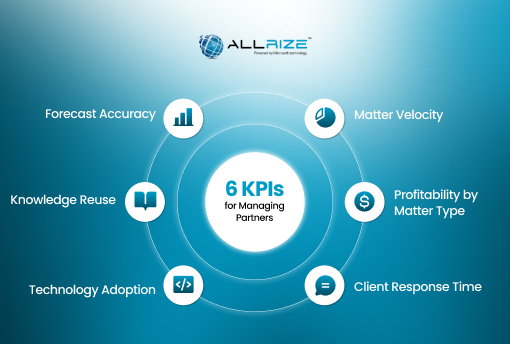
Here are six KPIs every managing partner should consider adding to their leadership dashboard.
1. Matter Velocity
Every matter has a lifecycle from intake to completion. One of the most valuable metrics a firm can monitor is how efficiently matters move through that lifecycle.
Delays can occur for countless reasons: waiting on client information, internal approvals, document reviews, staffing bottlenecks, or simply losing visibility into next steps. Individually, these delays may seem insignificant. Across hundreds or thousands of matters, they can have a measurable impact on profitability and client satisfaction.
Tracking matter velocity helps firm leaders identify where work slows down, streamline processes, and improve overall service delivery.
A matter sitting idle generates neither revenue nor client confidence.
2. Profitability by Matter Type
Revenue tells only part of the story.
Two practice areas may generate similar revenue while producing dramatically different profit margins. Matters with identical fee arrangements may require very different levels of attorney time, administrative support, and write-offs.
Understanding profitability by matter type allows firms to answer questions such as:
- Which matters consistently generate the strongest margins?
- Where are write-offs occurring most frequently?
- Are staffing models aligned with profitability?
- Which services should the firm continue to invest in?
Instead of simply asking, “How much revenue did this matter generate?” firms should also ask, “How profitable was it?”
3. Client Response Time
Clients increasingly expect responsiveness and transparency.
While the outcome of a matter will always be paramount, clients also judge their experience based on communication such as how quickly emails are answered, how frequently they’re updated, and whether they feel informed throughout the engagement.
Tracking metrics such as:
- Time to first client response
- Frequency of matter updates
- Average turnaround time on client requests
can help firms identify service gaps before they affect client relationships.
4. Technology Adoption
Many firms invest heavily in new technology, yet surprisingly few measure whether those tools are actually being used.
Purchasing software does not automatically improve firm performance. The return on investment comes from adoption.
Firm leaders should monitor metrics such as:
- User adoption rates
- Workflow completion
- Feature utilization
- Frequency of platform usage
These metrics can reveal whether employees are embracing new tools or reverting to manual processes and disconnected systems. They can also help guide future purchasing decisions.
5. Knowledge Reuse
One of the most overlooked costs in many law firms is duplicated work.
How often are attorneys recreating documents that already exist? Searching for prior work product? Drafting the same language from scratch?
Knowledge reuse measures how effectively a firm leverages its existing intellectual capital.
A strong knowledge management strategy enables attorneys to:
- Locate precedents more quickly
- Reuse approved work product
- Maintain consistency across matters
- Reduce time spent reinventing documents
As firms continue adopting AI, the value of organized, accessible knowledge will only continue to grow. AI performs best when it’s built on clean, connected, and well-managed firm data.
6. Forecast Accuracy
Managing partners are increasingly expected to make strategic decisions about hiring, staffing, budgeting, and growth.
Those decisions depend on one thing: reliable forecasting.
Can your firm accurately predict:
- Future revenue?
- Matter volume?
- Staffing needs?
- Resource allocation?
The more accurate those forecasts become, the more confidently firm leadership can make long-term decisions.
Rather than reacting to changing workloads, firms with strong forecasting capabilities can proactively plan for growth and allocate resources where they’re needed most.
Looking Beyond Traditional Metrics
Billable hours and revenue aren’t going away. They remain essential measures of law firm performance.
But they no longer tell the whole story.
Today’s most successful firms are also measuring operational efficiency, client experience, technology adoption, knowledge management, and predictive business insights. These KPIs provide leaders with a more complete understanding of how their firm is performing and where opportunities exist to improve.
With the right visibility, managing partners can move beyond simply measuring performance, they can actively shape the future of their firms.